

Dehumidifier for Dust Mites: Does Humidity Control Actually Work?
Dust mites thrive in humidity levels above 50% and struggle to survive below 50%. Dehumidifiers can help control dust mite populations by maintaining humidity between 30-50%, but they're most effective when combined with other allergen reduction strategies. The challenge is that even in low humidity, dust mites that have already died leave behind allergenic proteins that persist in your environment. Dehumidifiers address future mite reproduction, but don't eliminate existing allergen proteins, and that requires additional approaches!
Key Takeaways
- Dust mites cannot survive in humidity below 50%. They thrive above 50%.
- Whole-home dehumidification targeting 30-50% humidity reduces dust mite populations over weeks to months
- Dead dust mites and their fecal matter remain allergenic even after mites die from low humidity
- Dehumidifiers work best in naturally humid climates; dry climates may already have low enough humidity
- Combining humidity control with allergen-neutralizing strategies provides the most complete solution
- Bedroom-focused dehumidification offers the biggest impact since you spend 7-9 hours there nightly
The Science of Dust Mites and Humidity
Dust mites are microscopic creatures—about 0.3 millimeters long—that live in bedding, upholstered furniture, carpets, and anywhere that collects dead skin cells (their primary food source). You can't see them without magnification, but if you have allergies, you definitely feel their presence.
The primary allergen from dust mites is a protein called Der p 1, found in their fecal pellets. Yes, you're allergic to dust mite poop! A single dust mite produces about 20 droppings per day, and each dropping contains allergenic proteins. When these fecal pellets dry out and break apart, they become airborne, and you inhale them. That's what triggers sneezing, congestion, asthma symptoms, and all the misery dust mites cause.
Here's where humidity becomes critical: Dust mites don't drink water. They absorb moisture from the air through their exoskeleton. If humidity drops below 50%, they can't absorb enough water to survive, and they dehydrate and die.
A landmark 1999 study published in the Journal of Allergy and Clinical Immunology examined dust mite survival at different humidity levels:
- At 75% relative humidity: dust mites thrived and reproduced
- At 50-60% relative humidity: population growth slowed
- Below 50% relative humidity: dust mites couldn't reproduce effectively
- Below 35% relative humidity: existing dust mites died within days to weeks
This is why dehumidifiers are often recommended for dust mite control. In theory, if you maintain low enough humidity, you starve dust mites of the moisture they need to survive.
Does It Actually Work in Real Homes?
The research is clear in controlled laboratory conditions. But homes aren't laboratories, and that's where things get more complicated.
When my dad was researching solutions for my childhood allergies—before he developed what became our allergen spray—we tried dehumidifiers. We lived in an area with naturally moderate humidity, and we invested in whole-home dehumidification, thinking it would solve our dust mite problems.
Here's what we learned through experience and what research confirms:
Dehumidifiers reduce dust mite populations over time, but it's not instant. A 2000 study in the Journal of Allergy and Clinical Immunology found that maintaining 45% relative humidity or lower reduced dust mite allergen levels by approximately 50-70% over a three-month period. That's significant, but notice the timeline—months, not days or weeks.
Dead dust mites still cause allergies. This is the frustrating part. When humidity drops, and dust mites die, their bodies and their fecal pellets remain in your bedding, carpet, and furniture. Those proteins don't disappear just because the mites are dead. A 2006 study in Clinical & Experimental Allergy found that dust mite allergen levels remained elevated for months after mite populations were eliminated because the existing allergen load persisted.
Humidity control only works if maintained consistently. If you run a dehumidifier for a month, reduce the mite population, then stop, humidity rises again, and mites repopulate quickly. Dust mites reproduce rapidly—a single female can lay 40-80 eggs during her 2-3 month lifespan. Miss a week of dehumidification during humid summer weather, and you can undo weeks of progress.
Some areas of your home are harder to dehumidify than others. Bathrooms, basements, and poorly ventilated spaces tend to maintain higher humidity regardless of whole-home dehumidification efforts. Dust mites in these areas may survive even when your main living spaces reach ideal humidity levels.
Choosing the Right Dehumidifier for Dust Mite Control
If you decide dehumidification is worth trying—and in many cases, it absolutely is—choosing the appropriate equipment matters.
Whole-home dehumidifiers integrate with your HVAC system and dehumidify your entire house. These are the most effective for comprehensive dust mite control but also the most expensive, typically $1,500-$3,500 for equipment and installation. They work quietly, maintain consistent humidity throughout your home, and require minimal daily attention.
Whole-home units make sense if:
- You live in a naturally humid climate (coastal areas, Southeast US, tropical regions)
- Multiple people in your household have dust mite allergies
- You're committed to long-term humidity control as part of your allergen management strategy
- You have a central HVAC unit that the dehumidifier can integrate with
Portable dehumidifiers work in individual rooms and cost $150-$400, depending on capacity. These are practical for targeting specific areas, particularly bedrooms where you spend the most time.
For dust mite control, focus on:
- Capacity: Choose units rated for your room size. A too-small dehumidifier won't effectively maintain low humidity; an oversized one costs more and uses more energy than needed.
- Target humidity setting: Look for models that let you set specific humidity levels, ideally 35-45% for dust mite control
- Continuous drain option: Emptying collection tanks daily gets old fast. Models with continuous drain capability or pump drainage make long-term use sustainable
- Energy efficiency: These units run continuously, so Energy Star certification saves money over time
Bedroom-focused approach: Since you spend 7-9 hours sleeping, and beds are dust mite central (millions of dead skin cells accumulate in bedding), starting with bedroom dehumidification provides the biggest bang for your buck. A quality portable unit in each bedroom costs $300-$600 total and targets your highest-exposure time.
Optimal Humidity Levels for Dust Mite Control
The research is consistent: maintain relative humidity between 30-50% for effective dust mite control. More specifically:
45% or lower is ideal. At this level, dust mites struggle to survive, and reproduction slows dramatically. Existing mites dehydrate over weeks.
35% is aggressive and highly effective, but can feel uncomfortably dry for humans. Very low humidity can cause dry skin, irritated sinuses, and respiratory discomfort—particularly during winter when heating systems already dry indoor air. You might reach for lip balm more frequently. And static electricity becomes a frequent guest.
50% is the upper threshold. At 50% humidity, dust mites can still survive, though their populations grow more slowly than at higher humidity. If you can't maintain below 50% consistently, you're not getting the full dust mite control benefit.
Don't go below 30% long-term. Extremely low humidity causes wood furniture and flooring to crack, damages houseplants, and can worsen respiratory symptoms in some people. The sweet spot for dust mite control while maintaining human comfort is typically 35-45%.
Where Dehumidifiers Alone Fall Short
Here's the honest reality: dehumidifiers control future dust mite reproduction, but they don't address the allergens already present in your environment.
Think about it this way. You've had dust mites living in your mattress, pillows, carpet, and upholstered furniture for years. They've been producing Der p 1 protein (the primary allergen) in their fecal pellets all that time. Even if you achieve perfect humidity control tomorrow and every dust mite dies within a week, you still have years' worth of accumulated allergen protein in your environment.
A 2004 study in Indoor Air examined this exact issue. Researchers found that even after successful dust mite eradication through humidity control, allergen levels remained elevated for 6-12 months because existing allergen reservoirs persisted in fabrics and materials.
This is where dehumidifiers need to work alongside other strategies:
Washing bedding in hot water (130°F or higher) weekly kills dust mites and removes allergen proteins from sheets, pillowcases, and blankets. Dehumidifiers prevent new mites from establishing in freshly washed bedding.
Allergen-proof mattress and pillow covers create a barrier between you and the dust mite allergen reservoir in your bedding. These covers work whether or not you use dehumidifiers, and they complement humidity control by preventing new allergen accumulation.
HEPA vacuuming 2-3 times weekly removes surface dust mite allergen from carpets and upholstery. Standard vacuums can actually make things worse by aerosolizing allergens; HEPA filtration captures the particles instead of redistributing them.
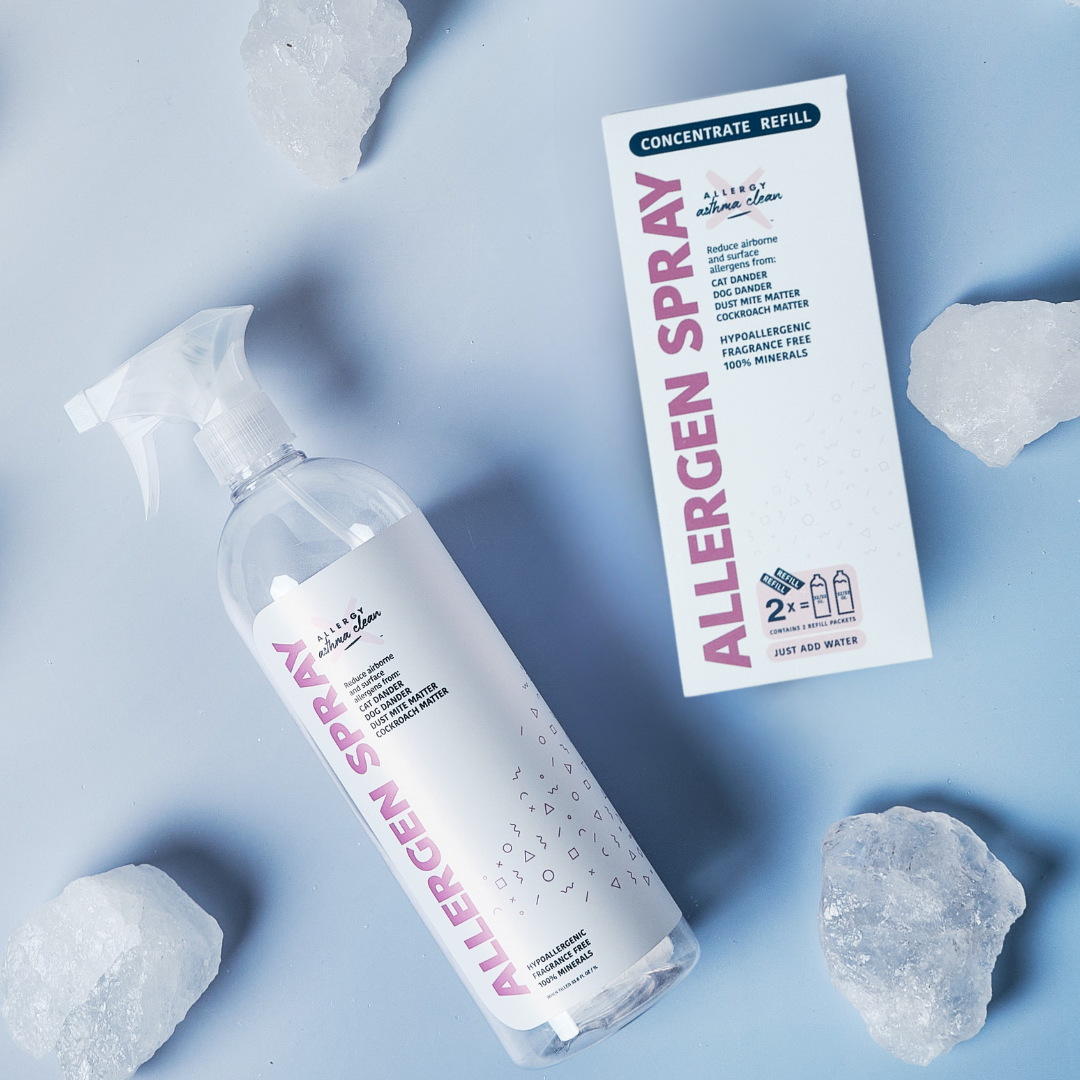
Neutralizing existing allergen proteins addresses the accumulated allergen load that dehumidification doesn't touch. This is where our family's approach differs from traditional dust mite management. My dad developed our allergen spray specifically to target allergenic proteins like Der p 1 at the molecular level.
The mineral-based formula uses FDA GRAS (Generally Recognized As Safe) compounds—sodium sesquicarbonate and mineral phosphate salts—that bind to allergen proteins through ionic interaction. This encapsulates the proteins and disrupts their stability, rendering them biologically inactive. You're not just reducing humidity to prevent future mites; you're neutralizing the proteins from existing allergens so they can't trigger your allergies.
We partnered with INBIO, the world leader in allergen detection, for third-party testing. Results showed up to 99% reduction in dust mite allergen on surfaces and in the air. That addresses the accumulated allergen problem that dehumidification alone can't solve.
Climate Considerations: Does Your Area Need Dehumidification?
Whether dehumidification makes sense depends heavily on where you live.
Naturally humid climates benefit most: If you live in areas where outdoor humidity regularly exceeds 60-70% (Southeast US, coastal regions, tropical areas), dehumidifiers are genuinely useful for dust mite control. Without mechanical dehumidification, maintaining indoor humidity below 50% is nearly impossible during humid months.
Dry climates may not need dehumidifiers at all: If you live in arid regions (Southwest US, high-altitude areas, desert climates), your indoor humidity is likely already below 50% most of the year. In these areas, dust mite control happens naturally. You might actually need humidification during winter to prevent excessive dryness.
Moderate climates are variable: Areas with seasonal humidity variation (much of the Midwest, Northeast, Pacific Northwest) may benefit from dehumidification during humid summer months but not need it year-round.
Check your current indoor humidity before investing in dehumidifiers. Inexpensive hygrometers (humidity sensors) cost $10-$30 and give you baseline data. If your indoor humidity already stays below 50%, dehumidifiers won't add much value for dust mite control.
The Cost-Benefit Analysis
Let's talk money, because dehumidifiers aren't free.
Initial equipment costs:
- Portable dehumidifiers: $150-$400 each (you need one per bedroom minimum for effective control)
- Whole-home dehumidifiers: $1,500-$3,500 including installation
Ongoing operating costs:
- Electricity: A typical portable dehumidifier uses 300-700 watts when running. At average US electricity rates ($0.14/kWh), that's roughly $30-$60 per month per unit if running continuously
- Whole-home units: $50-$100 per month during humid seasons
- Maintenance: Filter cleaning/replacement, coil cleaning, tank cleaning
Annual costs for aggressive dehumidification: If you run portable units in three bedrooms year-round, you're looking at roughly $1,000-$1,500 annually in electricity costs alone.
Compare that to:
- Allergen-proof mattress covers: $30-$80 each, one-time purchase lasting years
- Hot water washing: minimal incremental cost if you already do laundry
- HEPA vacuum: $200-$500 one-time cost
- Allergen-neutralizing spray: $30-$60 per month for regular use
Dehumidifiers are a significant investment, and the cost is recurring (electricity runs constantly). For some families, that investment pays off through symptom relief. For others, combination strategies using lower-cost approaches provide better value.
When Dehumidifiers Make the Most Sense
Based on research and customer conversations over the years, dehumidifiers for dust mite control make the most sense when:
You live in a humid climate where maintaining low indoor humidity requires mechanical dehumidification. This is not an option in some regions if you want dust mite control.
Multiple people in your household have dust mite allergies. If only one person is affected, targeted bedroom dehumidification might suffice. If several family members have allergies, whole-home dehumidification becomes more cost-effective.
You've implemented other strategies, but symptoms persist. Dehumidifiers work best as part of a comprehensive approach, not as a standalone solution. If you're already washing bedding weekly, using allergen-proof covers, vacuuming regularly, and neutralizing allergens but still struggling, humidity control might be the missing piece.
You're willing to commit long-term. Running dehumidifiers for a month doesn't provide lasting dust mite control. This is a years-long commitment, possibly permanent depending on your climate.
You can afford the operating costs. That $500-$1,000+ annual electricity cost needs to fit your budget comfortably without creating financial stress.
Alternatives and Complements to Dehumidification
If dehumidifiers don't make sense for your situation—whether due to climate, cost, or already having low humidity—other dust mite control strategies can be highly effective:
Freezing soft items: Dust mites die at temperatures below 0°F (-18°C). Placing pillows, stuffed animals, and small items in the freezer for 24-48 hours kills mites. This doesn't remove allergen proteins but prevents repopulation.
High-heat laundering: Water temperature above 130°F kills dust mites and removes allergens. Most people can increase their water heater temperature or use the "sanitary" cycle on modern washing machines.
Reducing dust mite habitat: Removing carpeting in favor of hard flooring, minimizing upholstered furniture, and reducing clutter all decrease the total dust mite population your home can support.
Allergen barriers: Allergen-proof encasements for mattresses, box springs, and pillows physically separate you from the dust mite reservoir in bedding.
Direct allergen neutralization: Using mineral-based sprays that bind to and denature Der p 1 proteins addresses the allergen load directly rather than just preventing future mite reproduction. You spray on mattresses, pillows, carpets, and upholstered furniture—anywhere dust mites live.
Our family learned through painful trial and error that no single approach solves dust mite allergies completely. Dehumidifiers help in humid climates, but they're one tool among many, not a magic solution.
Real Talk: What Actually Works
After my dad spent over a decade developing solutions for my severe childhood allergies, here's what we learned works in practice:
Start with the fundamentals. Before spending thousands on dehumidifiers, implement the basics: allergen-proof mattress and pillow covers, weekly hot-water washing, HEPA vacuuming, and reducing clutter (dust collectors).
Check your baseline humidity. Don't assume you need dehumidification without measuring. If you already have low humidity, you're solving a problem that doesn't exist.
Focus on bedrooms first. You spend more consecutive time in your bedroom than anywhere else. If your budget is limited, concentrate on dust mite control efforts here.
Address existing allergen proteins, not just future mites. This was the key insight my dad had when developing our allergen spray. Even with perfect humidity control going forward, you're still living with years of accumulated allergen proteins. Neutralizing those proteins provides immediate relief that complements the long-term benefit of reduced mite populations.
Be realistic about maintenance. Whether it's running dehumidifiers continuously, washing bedding weekly, or spraying allergen-neutralizing products regularly, dust mite control requires ongoing effort. Choose strategies you can actually maintain long-term.
The Bottom Line on Dehumidifiers for Dust Mites
Dehumidifiers work for dust mite control—the research is clear on that. Maintaining relative humidity between 30-50% reduces dust mite populations significantly over time.
But dehumidifiers aren't a complete solution. They control future mite reproduction without addressing existing allergen accumulation. They require consistent, long-term use and significant electricity costs. And they're most effective in naturally humid climates where indoor humidity naturally exceeds 50%.
For our family, the breakthrough came from understanding that dust mite allergies are fundamentally about proteins (Der p 1, Der f 1) that trigger immune responses. Whether those proteins come from living mites or dead ones doesn't matter to your immune system. Controlling mite populations helps, but neutralizing the allergenic proteins—both from existing mites and future ones—addresses the problem more completely.
If you live in a humid climate and can afford the operating costs, dehumidifiers are worth including it in your dust mite control strategy. Just don't expect them to solve the problem alone. Combine humidity control with allergen barriers, regular cleaning, and protein-neutralizing approaches for the most complete solution.
The reality is that dust mite control requires multiple strategies working together. Dehumidifiers can be part of that, but they're not the whole answer—they're one piece of a larger puzzle.